
A fault found on site costs days: a crane, a shutdown, a technician flown in, a contractor waiting. The same fault found at the factory costs an hour. That is the whole case for a factory acceptance test (FAT). This checklist covers what a consultant, contractor or end user should check when they witness the test of a low-voltage switchboard, and which papers they should leave the factory with.
What a FAT is, and what it is not
A FAT is a test of the finished board at the manufacturer's works, witnessed by the buyer or their engineer, before the board is packed. It confirms that this specific board matches the approved drawings and passes its tests.
It is not a repeat of the design verification. Under IEC 61439, design verification (temperature rise, short-circuit withstand, dielectric and so on) is done once for the switchboard system, by the original manufacturer. What you witness at a FAT is the routine verification that IEC 61439-1 requires on every assembly, plus the functional checks your project needs. Our guide to IEC 61439 explains the difference.
Before the visit
Most failed FATs fail on paperwork, not on hardware. Agree these points in writing at least a week before the date:
- The FAT procedure: the list of tests, the instruments, the pass criteria and who signs. Ask the manufacturer to send it for comment.
- The drawing revision: the board is tested against the latest approved general arrangement, single-line diagram and wiring diagrams. Bring your own approved copies.
- Open variations: any change agreed by email after approval (a feeder rating, a meter type, a cable entry) should be listed, so nobody marks it as a defect.
- Who attends: the person who signs must be able to accept the board on behalf of the client. A witness without authority means a second visit.
Documents to review on the day
- Approved single-line diagram, general arrangement and wiring diagrams, at the revision you agreed
- Bill of materials with makes, part numbers and ratings
- Design verification evidence for the switchboard system (test reports or the original manufacturer's declaration)
- Routine verification report for this board, filled in by the factory before you arrive
- Calibration certificates of the test instruments (insulation tester, high-voltage tester, multimeter, torque wrench)
- Protection relay settings and breaker trip settings, if the project gave them
Visual and mechanical checks
| Check | What to look for |
|---|---|
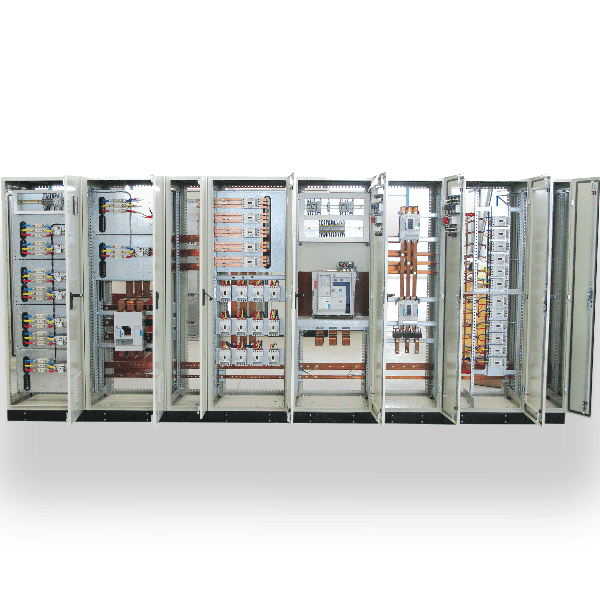
| Dimensions and layout | Height, width, depth, cubicle order and cable entry (top or bottom) match the general arrangement. Measure, do not estimate. |
| Nameplate | Manufacturer, type, IEC 61439 reference, rated voltage, rated current, short-circuit rating, IP code, serial number. |
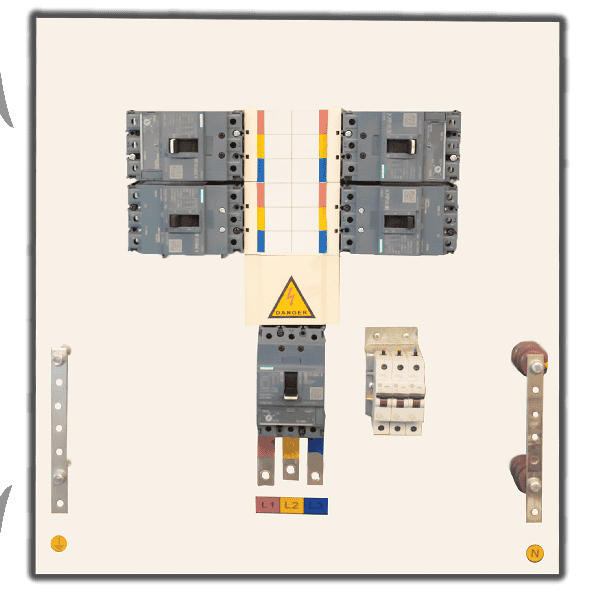
| Components | Every breaker, contactor, meter and relay matches the bill of materials: make, rating, breaking capacity, number of poles. |
| Busbars and joints | Cross-section as designed, torque marks on every bolted joint, phase colours or labels in the right sequence. |
| Wiring | Ferrules or markers matching the wiring diagram, no damaged insulation, cables supported and clear of sharp edges. |
| Internal separation | Barriers and covers in place for the specified form of separation. |
| Mechanical operation | Doors, locks, handles, interlocks, withdrawable units and shutters move freely and lock as intended. |
| Paint | Colour (for example RAL 7035), even finish, no runs or bare edges. Ask for a dry film thickness reading on a few points. |
| Labels | Feeder labels and warning labels in the language and wording of the specification. |
The IEC 61439 routine tests
IEC 61439-1 lists the routine verification that every assembly must pass. At a FAT you can ask to see each one carried out, or carried out on a sample of circuits when the board is large:
- Degree of protection of the enclosure: covers, gaskets and entries in place for the rated IP code.
- Clearances and creepage distances where they cannot be confirmed by the design alone.
- Protection against electric shock and the protective circuit: continuity between exposed metal parts and the main earth bar, checked with a low-resistance test.
- Built-in components: installed and identified as the manufacturer's instructions require.
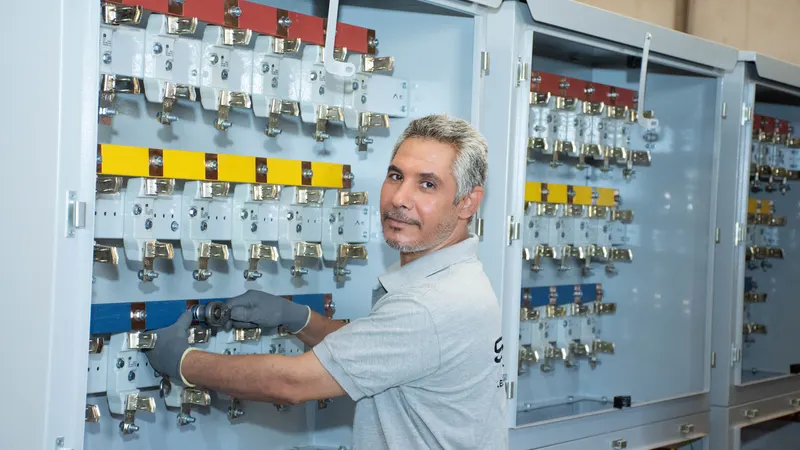
- Internal circuits and connections: tightness of connections, checked on a sample.
- Terminals for external conductors: number, type and size suitable for the specified cables.
- Mechanical operation of operating elements, locks and interlocks.
- Dielectric properties: a power-frequency withstand test between live parts and earth and between phases. For assemblies whose incoming protection is rated up to 250 A, the standard allows an insulation resistance measurement instead.
- Wiring, operational performance and function: the board does what the schematic says.
Before the high-voltage test, make sure electronic devices that cannot take it (meters, relays, surge protectors, some controllers) have been disconnected as the procedure says, and reconnected afterwards.
Functional tests worth asking for
- Control circuits: energise the auxiliary supply and operate every control from its pushbutton, selector or remote input.
- Interlocks and changeover: for an ATS or a bus coupler, run every sequence on the logic diagram, including the ones that must be blocked.
- Protection: secondary injection of protection relays and electronic trip units, using the project settings.
- Metering: inject current and voltage and compare the meter reading with the test set.
- Indication and alarms: lamps, alarms and signals to the building management system, point by point.
- Capacitor banks: step switching and the power factor controller's response.
The punch list and sign-off
Few large boards pass a FAT with no comments. What matters is that every comment is written down, classified and closed:
- Category A: must be fixed and re-tested before the board ships.
- Category B: can be fixed before shipment and confirmed by photo or report, without a second visit.
- Category C: can be closed on site, with the responsible party named.
Leave with a signed FAT report, the punch list with its categories, the completed routine verification report and the release for shipment. These go into the handover file together with the as-built drawings.
Witnessing a FAT at SEGA M
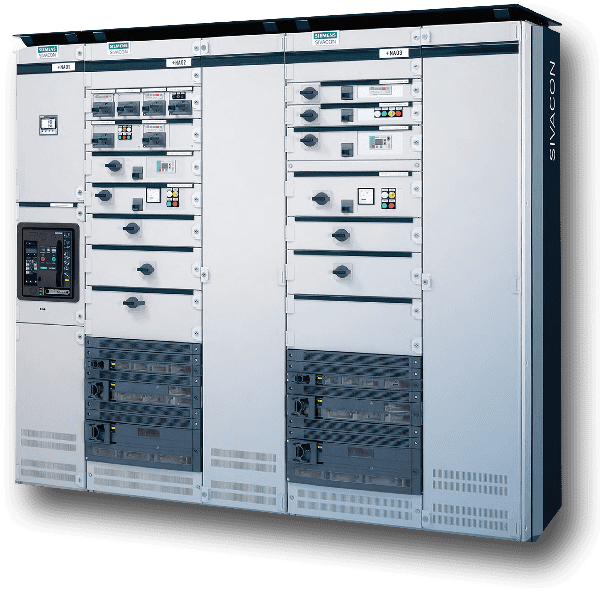
SEGA M builds low-voltage switchboards in its 30,000 m² factory in 10th of Ramadan City, near Cairo: SIVACON S8 as a Siemens Advanced Partner, our own SG-1 switchgear up to 4,000 A, and the type-tested MFB load centres and NSFB distribution boards. Every board is routine-tested before it leaves the factory, and our laboratory is accredited by EGAC to ISO/IEC 17025 for coating thickness, IP and IK tests.
Clients and consultants are welcome to witness the tests, Saturday to Thursday, 8:00 to 16:00 Cairo time. If you would also like to see the production lines, the laboratory and the showroom, plan to arrive by 2 pm. If you cannot travel, we can hold an online meeting during the tests. Tell us when you place the order, and include the FAT in your request for quotation.
Frequently asked questions
What is the difference between a FAT and a SAT?
A FAT is done at the factory before shipment. A site acceptance test (SAT) is done after installation, with the real cables and supplies connected. The FAT reduces what can go wrong on site; it does not replace the SAT.
Is a FAT required by IEC 61439?
No. IEC 61439 requires routine verification of every assembly, which the manufacturer does anyway. Witnessing it, and adding functional tests, is agreed in the contract.
How long does a switchboard FAT take?
A small distribution board can be checked in an hour or two. A main switchboard with many sections, an ATS and protection relays can take a full day. Agree the duration with the test procedure.
Can we witness a FAT at SEGA M remotely?
If you cannot travel, we can hold an online meeting during the tests. The signed test reports are sent with the board.