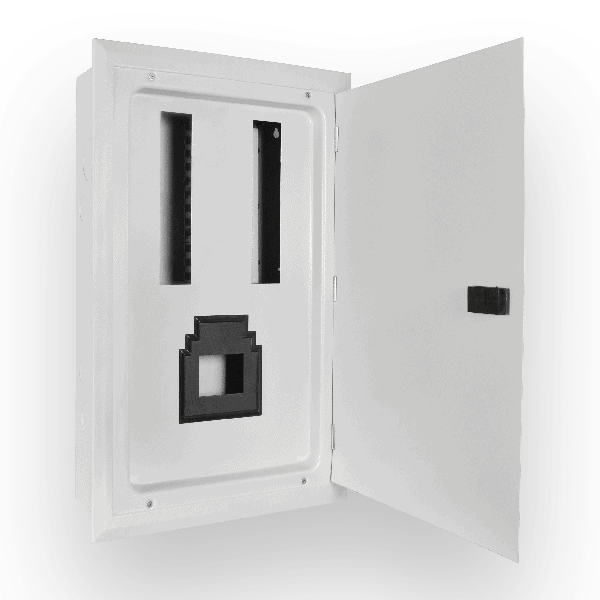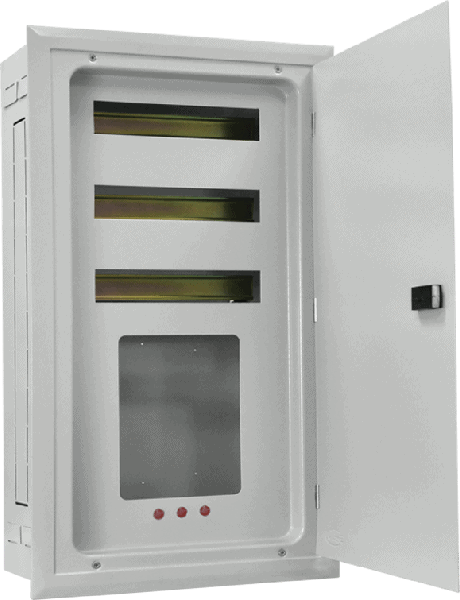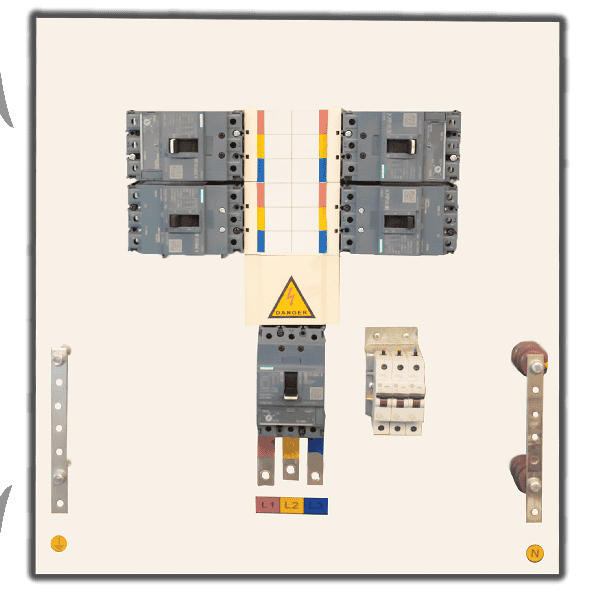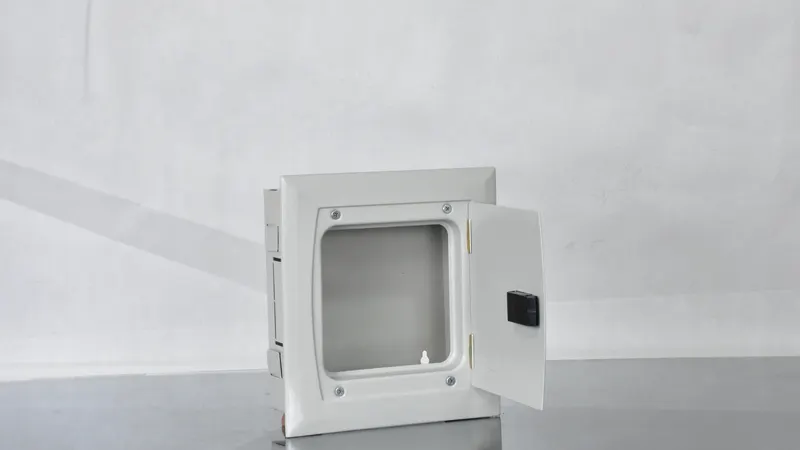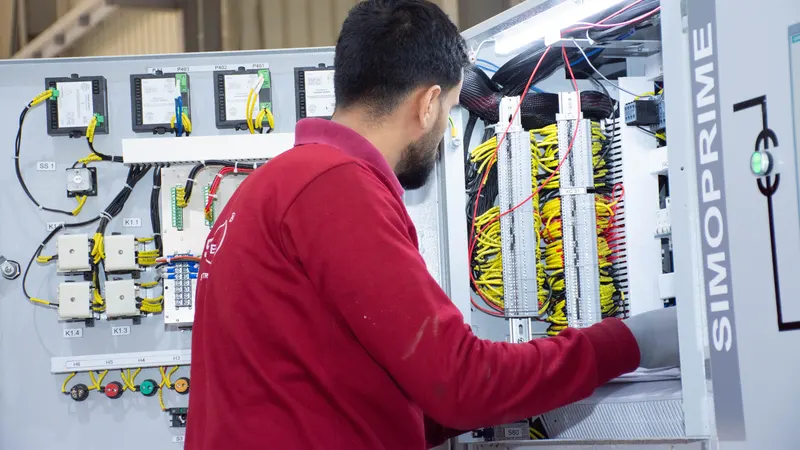

Open an older distribution board and you often find a nest of short wires running from the main switch to every circuit breaker. Each one is a joint that can loosen, overheat or be connected to the wrong phase. A fishbone board removes most of them. The incomer feeds a busbar system shaped like a fish skeleton, and the miniature circuit breakers (MCBs) take their supply directly from its branches. This guide explains how that works, where it pays off and how to specify one.
What a fishbone board is
A fishbone distribution board has a main busbar running along the centre of the board, the "spine", and short branches, the "bones", leading out to the rows of MCBs on each side. In a three-phase board the branches are connected to L1, L2 and L3 in turn, so consecutive outgoing positions sit on different phases. The neutral and earth have their own bars with one terminal per outgoing way.
The result is a board where the supply path from the incomer to each MCB is made of rigid copper with fixed spacing, instead of cut-to-length cables. It is the same idea that larger switchboards use with busbar systems, scaled down to final distribution.
Why engineers choose fishbone boards
- Fewer joints, fewer faults. Every internal wire has two terminations. Removing them removes the most common cause of hot spots in small boards.
- Phase balance by design. Because the branches alternate between phases, spreading circuits evenly across L1, L2 and L3 is natural rather than an afterthought.
- Faster, tidier installation. The installer connects outgoing cables only; the internal distribution is finished at the factory.
- Repeatable quality. A factory-built busbar system can be tested as a design. A hand-wired board is only as good as the person who wired it.
- Easy extension. Spare ways are already fed. Adding a circuit means fitting an MCB, not rewiring.
Fishbone board vs DIN-rail board with comb busbar
| Fishbone board | DIN-rail board with comb busbar | |
|---|---|---|
| Supply to MCBs | Rigid busbar branches from a central spine | Comb busbar clipped across a row of MCBs, fed by wires from the incomer |
| Internal wiring | Minimal | Wires from incomer to each row |
| Phase allocation | Fixed by the busbar layout | Set by the comb type and wiring |
| Typical rating | Up to about 250 A | Usually lower, limited by the comb and wiring |
| Best for | Hotels, offices, hospitals, residential towers, repeated floor boards | Small boards with few circuits |
Both are valid. The fishbone design earns its place when a project has many similar boards, or when circuits are numerous enough that internal wiring becomes a reliability risk.
What to specify
| Item | Why it matters |
|---|---|
| Busbar rating | The current the spine can carry continuously, for example 160 A. It must cover the incomer setting. |
| Short-circuit rating | The fault level the board must withstand at its location, for example 16 kA for 1 s. Ask for the value at your point in the network. |
| Number of ways | Outgoing single-pole positions per phase, plus 20 to 30 % spare. See our guide to sizing a distribution board. |
| Incomer | MCB, isolator or moulded-case breaker (MCCB), with its rating and breaking capacity. |
| Residual current protection | Whether RCDs or RCBOs are needed for socket and wet-area circuits. |
| Enclosure | Surface or flush mounting, IP rating, colour (often RAL 7035), cable entry top or bottom. |
| Metering | Space for a utility or sub-meter if the board feeds a tenant or apartment. |
Common mistakes
- Choosing ways without spares. A board that is full on handover will be modified badly later.
- Ignoring the fault level. A board near the main switchboard of a large building may see a higher fault current than the same board on the top floor.
- Unbalanced phases. The busbar makes balance easy, but the circuit schedule still has to use it. Put large single-phase loads on different phases.
- Mixing brands of MCB without checking. MCBs must fit the busbar connection system the board was designed and tested with.
Fishbone boards from SEGA M
SEGA M builds the type-tested NSFB fishbone distribution board in its factory in 10th of Ramadan City, Egypt: 160 A busbar, 16 kA for 1 s, 12 to 60 outgoing MCB positions, up to IP42, in RAL 7035 or RAL 7032. Incomers range from a three-pole miniature breaker to 100 A and 160 A moulded-case breakers. For larger sub-main loads, the MFB load centre uses the same principle with MCCB feeders at 250 A or 400 A.
For apartments and shops, our boards with built-in meter space, such as the 36-line panel with meter, combine distribution and metering in one enclosure. Send us your circuit schedule and we will propose the board for each floor or unit.
Frequently asked questions
Why is it called a fishbone board?
The busbar looks like a fish skeleton: a central spine with short branches on both sides, each branch feeding the MCBs in one row.
Is a fishbone board better than a normal DIN-rail board?
For boards with many circuits, yes in most cases: it removes most internal wiring, fixes the phase allocation and is easier to extend. For a very small board, a DIN-rail board is often enough.
What rating does a fishbone board have?
It depends on the design. SEGA M's NSFB board has a 160 A busbar and is rated 16 kA for 1 s, with 12 to 60 outgoing ways.
Can I add circuits later?
Yes. Spare ways are already fed by the busbar, so adding a circuit means fitting a compatible MCB and connecting the outgoing cable.