A switchboard nameplate that says 2,500 A does not mean 2,500 A everywhere. The rating holds for the service conditions the board was designed and verified for. Put the same board in a plant room that reaches 50 °C in August, close the doors and fill it with heavily loaded feeders, and it will run hotter than its design allowed. In the Gulf, North Africa and the Sahel this is a daily condition, not an exception.
The ambient temperature behind every rating
IEC 61439-1 defines normal service conditions for indoor assemblies: an ambient air temperature that does not exceed 40 °C, with an average over 24 hours that does not exceed 35 °C. The temperature-rise verification of a switchboard system is made against these conditions, and the rated currents of the busbars and functional units follow from it.
If the real ambient is higher, the standard treats it as a special service condition. It has to be stated by the user and agreed with the manufacturer. A board specified without a site temperature will be designed for 35 °C.
Where the heat comes from
- Losses in the board: busbars, joints, breakers, contactors, fuses, meters and cable terminations all dissipate power, roughly in proportion to the square of the current.
- The room: a switchroom with poor ventilation, a sun-facing wall or a roof slab exposed to the sun can sit well above outdoor shade temperature.
- Solar gain: an outdoor board in direct sun absorbs heat through its roof and sides, especially if it is painted a dark colour.
- The enclosure itself: a higher IP code means fewer and smaller openings, so less heat escapes by natural convection.
How components react to heat
Circuit breakers are calibrated at a reference temperature, given by the breaker manufacturer. Thermal trip units in particular respond to the air around them: inside a hot enclosure a breaker can trip below its set current, or its permitted continuous current has to be reduced. Manufacturers publish derating tables for this, and the panel builder should use them for the temperature inside the board, not the room.
Busbars follow the same physics. A busbar sized for a 35 °C average ambient will exceed its permitted temperature rise at the same current in a hotter room, unless its cross-section is increased or its current reduced.
Rated diversity factor: the second lever
IEC 61439 introduced the rated diversity factor (RDF): the share of their rated current that the outgoing circuits of a board can carry at the same time, continuously, without overheating. A board with an RDF of 0.8 can run all its feeders at 80 % of their rating together.
In a hot climate the RDF and the ambient temperature work together. If the site has a high ambient and a high, steady load (air conditioning, pumps, desalination, process plant), say so. A board designed for an office building with a typical diversity will not behave the same way in a cement plant at noon.
IP rating against ventilation
Hot regions are often dusty too, and that creates a conflict. Ventilation openings let heat out but also let dust and sand in. A sealed IP54 or IP65 board keeps the dust out but keeps the heat in. The usual solutions are:
- a cooler switchroom (air conditioning or forced ventilation with filters), so the board can stay sealed;
- filtered fans or roof vents on the board, with a filter maintenance plan;
- a larger enclosure or larger busbars, so the same current produces less heat per unit of surface;
- for outdoor boards, a double roof or sun shield, a light colour such as RAL 7035, and a location out of direct afternoon sun.
Our guide to IP ratings explains which code fits which location.
What to write in your specification
| Item | Example |
|---|---|
| Maximum ambient temperature | 50 °C |
| 24-hour average ambient | 40 °C |
| Location | Indoor, switchroom with forced ventilation / outdoor, direct sun |
| Altitude | Only if above 2,000 m, where air cools and insulates less well |
| Required IP code | IP54 |
| Rated diversity factor | The loading you really expect, for example 0.9 for continuous process loads |
| Dust or sand | Yes, wind-blown sand |
| Spare capacity | For example 20 % spare feeders, and whether they will be loaded later |
With these figures the panel builder can derate the busbars and breakers correctly and show you the calculation, instead of assuming a 35 °C average ambient by default.
Switchboards from SEGA M for hot sites
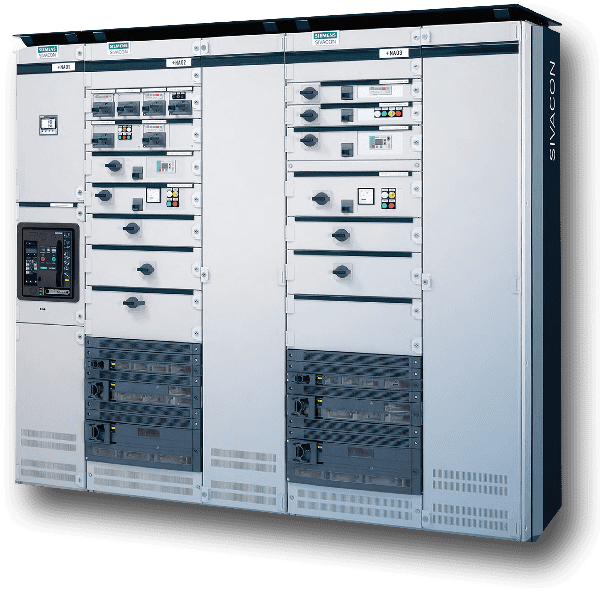
SEGA M builds switchboards in Egypt for projects in Egypt, Libya, Iraq and Sub-Saharan Africa, where high ambient temperatures and dust are normal working conditions. SIVACON S8, built by SEGA M as a Siemens Advanced Partner, goes up to 7,010 A at IP54, and our SG-1 switchgear covers MDB, MCC, power factor correction and ATS boards up to 4,000 A at IP54. For sub-distribution in harsh areas, the MFB load centre reaches IP65.
Send us the site temperature, the location and the load profile with your single-line diagram, and our engineers will size the board for the conditions it will really see. Our RFQ checklist lists the other details we need.
Frequently asked questions
At what ambient temperature are switchboards rated?
Under IEC 61439-1 normal service conditions for indoor use, the ambient does not exceed 40 °C and its 24-hour average does not exceed 35 °C. Higher temperatures must be stated and agreed with the manufacturer.
Does a higher IP rating reduce the current a switchboard can carry?
It can. A more sealed enclosure lets less heat escape, so at the same current the inside runs hotter. The panel builder accounts for this in the design.
What is a rated diversity factor?
It is the share of their rated current that all outgoing circuits of a board can carry at the same time, continuously, within the permitted temperature rise.
Is air conditioning in the switchroom necessary?
Not always. It is one option. A larger enclosure, larger busbars, filtered ventilation or a lower loading can also keep a board within its limits. The right choice depends on the site and the cost of each option.