A municipality or contractor buying LED street lights usually receives offers that list wattage first. Wattage tells you what the light consumes, not how well it lights the road. Two 150 W luminaires can differ by 30 % in light output and far more in how that light lands on the road. This checklist covers what to compare, what to ask for, and what we measure in our own photometric laboratory before a SEGA M street light leaves the factory.
1. Compare luminaire efficacy, not LED chip efficacy
Efficacy is light output divided by power, in lumens per watt (lm/W). The number that matters is the efficacy of the complete luminaire, measured with its driver, optics and glass. LED chip datasheets quote much higher figures that never reach the road. Ask for the luminaire's measured flux and power, and calculate lm/W yourself.
As a reference, our Pacific street light delivers 13,260 lm at 105 W, which is 125 lm/W for the complete luminaire, and 17,255 lm at 150 W.
2. Light distribution matters more than total lumens
A street light must put light on the carriageway and the footpath, not into windows or the sky. The shape of the beam comes from the optics: lenses, reflectors and the angle of the light. Two luminaires with the same lumens can give very different results on a 7 m road with poles every 30 m.
The only reliable way to compare is a lighting calculation. Ask every supplier for photometric files (IES or LDT/EULUMDAT) measured on a goniophotometer, then run them in DIALux or similar software for your real road: width, number of lanes, pole height, spacing, arm length and tilt. Compare the results against the lighting class required for the road (for example the M and P classes of EN 13201 or CIE 115).
3. Colour temperature and colour rendering
- 4000 K (neutral white) is the most common choice for main roads.
- 3000 K (warm white) suits residential streets, historic centres and areas near nature, with less blue light.
- 6000 K (cool white) is still requested on some highway and industrial projects.
Colour rendering (CRI or Ra) of 70 is acceptable for roads; 80 or more helps in pedestrian areas and where cameras need true colours.
4. IP, IK and the housing
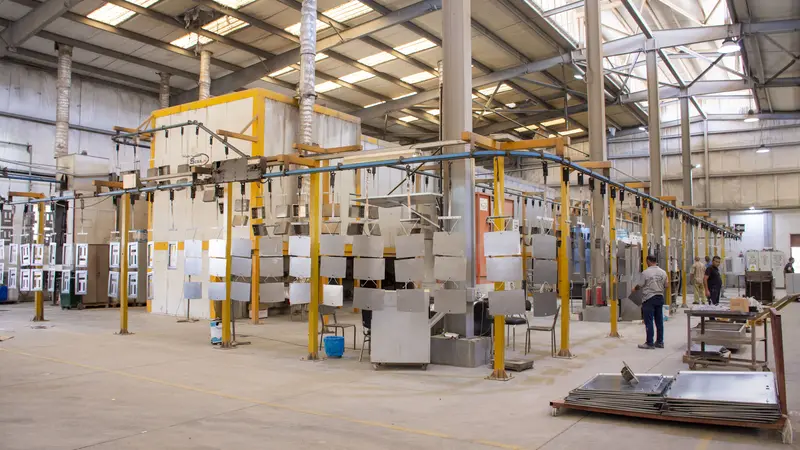
A street light lives outdoors for many years with rain, dust, heat and vandalism. Look for at least IP65 for the optical and driver compartments and IK08 for impact (5 joules). Die-cast aluminium housings carry heat away from the LEDs, and heat is what shortens LED life. Ask how the housing is coated: a pre-treatment before powder coating resists corrosion far better on coastal and humid sites. Our guide to IP ratings explains the codes in detail.
5. Driver, power factor and surge protection
- Power factor above 0.95 keeps the network efficient. Our Pacific and Rocky luminaires measure 0.98 to 0.99.
- Surge protection: long overhead networks and lightning cause voltage surges that kill drivers. Ask for the surge rating in kV for both line-to-line and line-to-earth, and add a separate surge protection device where the network is weak.
- Voltage range: in many African and Middle Eastern networks the voltage varies widely. Ask for the driver's working range.
- Dimming and controls: if you plan night-time dimming or a central management system, agree the driver type and the socket at the start.
6. Documents to ask for
- Photometric files (IES/LDT) measured on a goniophotometer, per model and colour temperature
- A lighting calculation for your road, signed by the supplier's engineer
- Test reports for luminous flux, efficacy, IP and IK
- Driver datasheet with surge rating and voltage range
- Approvals or homologations required by your utility or municipality
- Warranty terms in writing
Replacing old sodium lamps
Many cities replace high-pressure sodium (HPS) lanterns with LED. LED luminaires usually do the same job at a fraction of the wattage, but the right LED wattage must come from a lighting calculation on the existing poles, not from a conversion table. Keep the pole spacing in mind: if poles are far apart, an optic with a wide, flat beam matters more than extra lumens.
SEGA M street lights
SEGA M designs and manufactures LED street lights in Egypt. The Pacific (105 W and 150 W, IP65, IK08, die-cast aluminium, PMMA lenses with a tempered glass shield) is our heavy-duty model for highways and main roads, and the Pacific 150 W is homologated by CIE, the electricity company of Côte d'Ivoire. The Rocky (105 W and 150 W, with lens or lens-free optics) serves main roads and urban streets. Both are available in 3000 K, 4000 K and 6000 K.
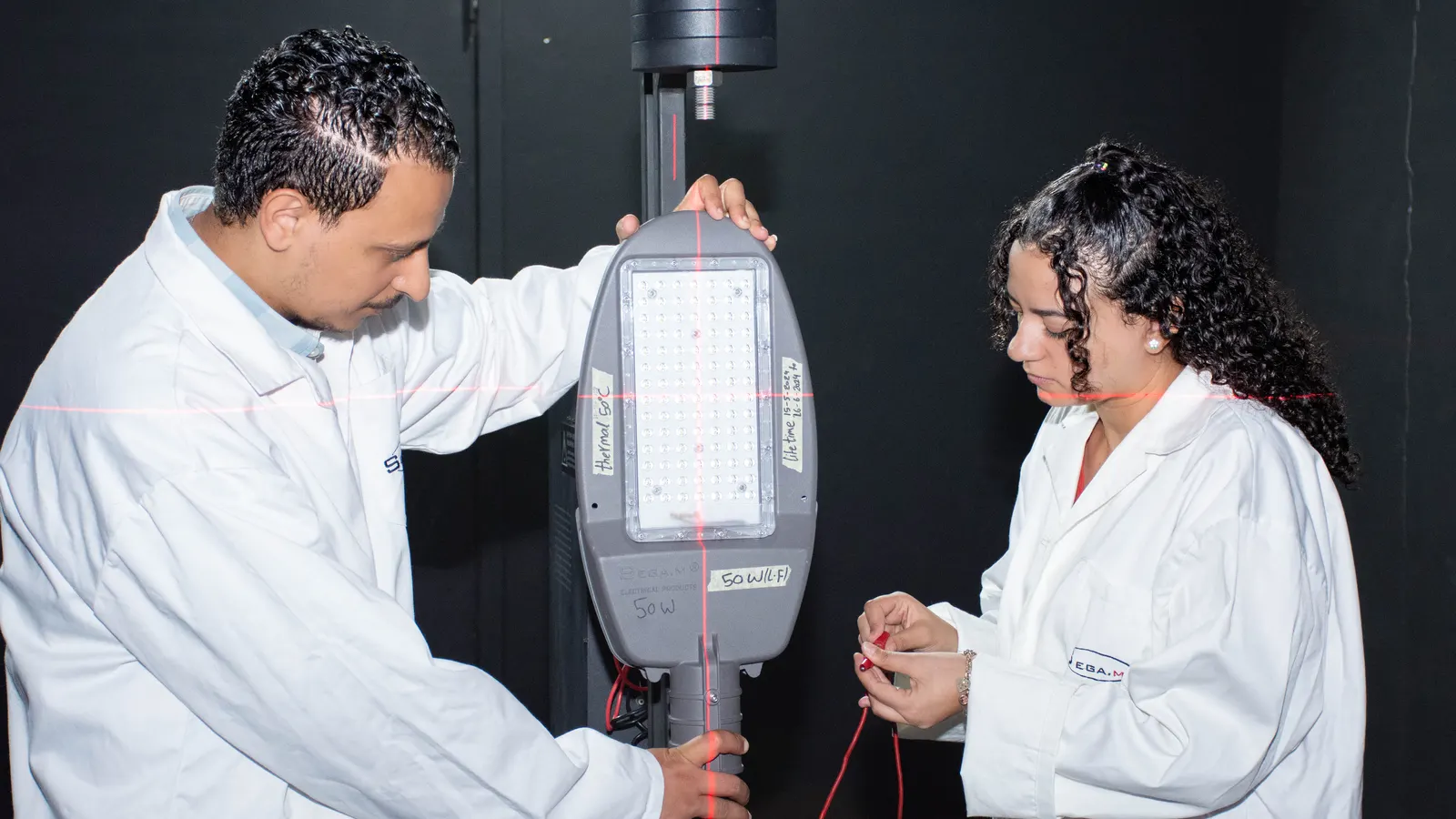
Our laboratory, accredited by EGAC to ISO/IEC 17025 for light measurement, IP and IK, measures every model on a goniophotometer and provides the photometric files. Send us your road layout and we will run the lighting calculation for you.
Frequently asked questions
What efficacy should a good LED street light have?
Compare complete-luminaire figures. Many good street lights today reach 110 to 130 lm/W; SEGA M's Pacific 105 W measures 125 lm/W.
Which colour temperature is best for street lighting?
4000 K is the most common for main roads. 3000 K is preferred for residential and sensitive areas.
Why do I need photometric files?
They let you calculate the real light levels on your road with software such as DIALux. Without them you cannot compare luminaires fairly.
What IP and IK rating should a street light have?
At least IP65 and IK08 for typical roads; IP66 for very exposed or coastal sites.