Most tender specifications still ask for a "type-tested" low-voltage switchboard. The phrase comes from IEC 60439, the standard that IEC 61439 replaced in 2014. The idea behind it is still right: the design must be proven before a panel reaches site. What changed is how that proof is described and who is responsible for it. This guide explains the system in plain terms, lists the ratings you should put in your specification, and gives you a short list of documents to request from any panel builder, including us.
From IEC 60439 to IEC 61439
IEC 60439 split assemblies into "type-tested" (TTA) and "partially type-tested" (PTTA). In practice many boards were called type-tested when only part of the design had been tested. IEC 61439 removed both terms. Every assembly now needs two things:
- Design verification, done once for a design, by test, by calculation or comparison with a tested reference design, or by assessment against design rules.
- Routine verification, done on every single assembly before it leaves the factory.
The old IEC 60439 series was withdrawn at the end of its transition period in November 2014. If a specification or a supplier's document still quotes IEC 439-1 or EN 60439-1 for a new board, ask for the IEC 61439 references instead.
The parts of IEC 61439
| Part | Covers |
|---|---|
| IEC 61439-1 | General rules, used together with one of the product parts below |
| IEC 61439-2 | Power switchgear and controlgear assemblies (PSC): main switchboards, MCC, sub-main boards |
| IEC 61439-3 | Distribution boards intended to be operated by ordinary persons (DBO) |
| IEC 61439-4 | Assemblies for construction sites |
| IEC 61439-5 | Assemblies for power distribution in public networks |
| IEC 61439-6 | Busbar trunking systems |
For an industrial or commercial main board, the part to name is IEC 61439-2.
Two manufacturers, two responsibilities
IEC 61439 separates the original manufacturer, who designed the system and carried out the design verification, from the assembly manufacturer, who builds the finished board for your project and carries out routine verification. They can be the same company or two companies.
SIVACON S8 is a good example. Siemens is the original manufacturer and holds the design verification of the system. SEGA M builds SIVACON S8 boards in Egypt as a Siemens Advanced Partner and is the assembly manufacturer: we build to the Siemens design rules and carry out the routine verification on each board. For our own designs, such as the MFB load centre and the NSFB distribution board, SEGA M is both.
What matters for you: the board you receive must stay inside the verified design. A builder who changes busbar sizes, breakers or enclosure without new verification has left the verified design, whatever the nameplate says.
What design verification covers
Clause 10 of IEC 61439-1 lists the characteristics that must be verified for a design. The main ones are:
- Strength of materials and parts, including corrosion and UV resistance
- Degree of protection of the enclosure (IP code)
- Clearances and creepage distances
- Protection against electric shock and integrity of protective circuits
- Incorporation of switching devices and components
- Internal electrical circuits and connections, and terminals for external conductors
- Dielectric properties (power-frequency and impulse withstand)
- Temperature-rise limits
- Short-circuit withstand strength
- Electromagnetic compatibility (EMC)
- Mechanical operation
Two of these, temperature rise and short-circuit withstand, decide whether a board survives its life on site. Ask how they were verified. Test is the strongest proof; calculation and comparison are allowed only within limits the standard sets.
What routine verification covers
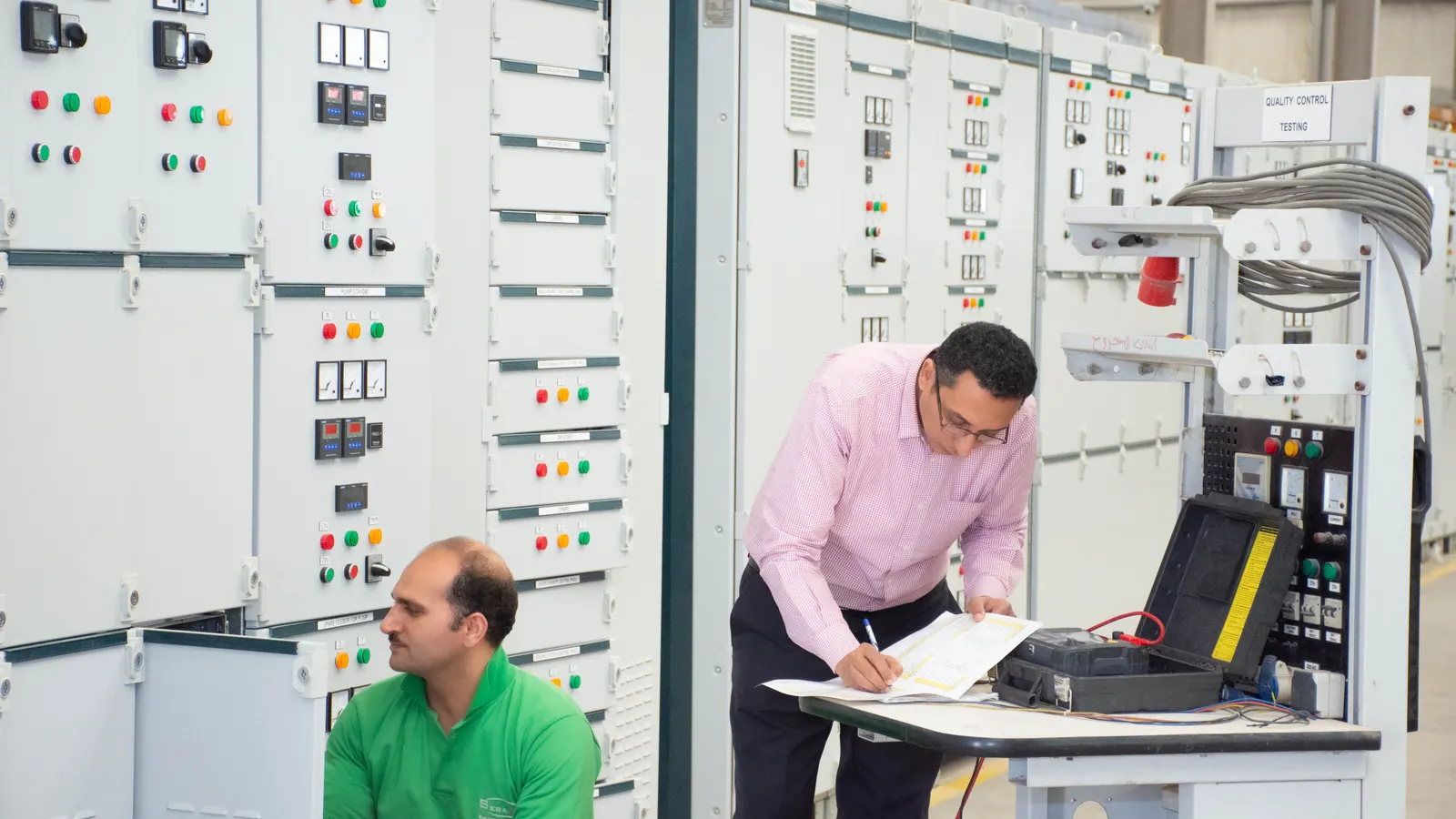
Routine verification is done on each finished assembly. It checks that the board was built as designed: degree of protection, clearances and creepage, protection against electric shock, correct built-in components, internal circuits and connections, terminals, mechanical operation, a dielectric test, and wiring and functional checks. The result is a routine test report for your board, with its serial number. At SEGA M every switchboard is routine-tested in the factory before shipping, and customers are welcome to witness the factory acceptance test (FAT).
The ratings to put in your specification
A clear specification saves weeks of clarification. These are the IEC 61439 characteristics a panel builder needs:
| Rating | Symbol | Why it matters |
|---|---|---|
| Rated operational voltage | Ue | System voltage, for example 400 V or 690 V |
| Rated insulation voltage | Ui | Sets clearances and creepage |
| Rated impulse withstand voltage | Uimp | Overvoltage category of the installation |
| Rated current of the assembly | InA | Main busbar and incomer size |
| Rated current of each circuit | Inc | Outgoing feeders |
| Rated short-time withstand current | Icw | Fault level at the board, for example 50 kA for 1 s |
| Rated peak withstand current | Ipk | Peak of the first fault cycle |
| Rated diversity factor | RDF | How many circuits run at full load together |
| Degree of protection | IP | Indoor, outdoor, dust, water |
| Form of internal separation | Form 1 to 4 | Safety and service continuity (see our guide on forms) |
Add the ambient temperature, the altitude if above 1,000 m, the pollution degree and the EMC environment. Boards for hot climates in Africa and the Gulf often need derating, so state the real site temperature rather than the standard 35 °C average.
Documents to ask your panel builder for
- The design verification evidence for the system offered, from the original manufacturer, covering the ratings you specified.
- Confirmation that the offered configuration stays within that verified design.
- The routine test report for each board, by serial number.
- General arrangement and single-line drawings, and the bill of materials.
- A nameplate showing the assembly manufacturer, type designation, date and the IEC 61439 part.
- Utility or authority approvals required in your country.
A serious builder sends these without hesitation. If the answers are vague, treat that as the answer.
How SEGA M works with IEC 61439
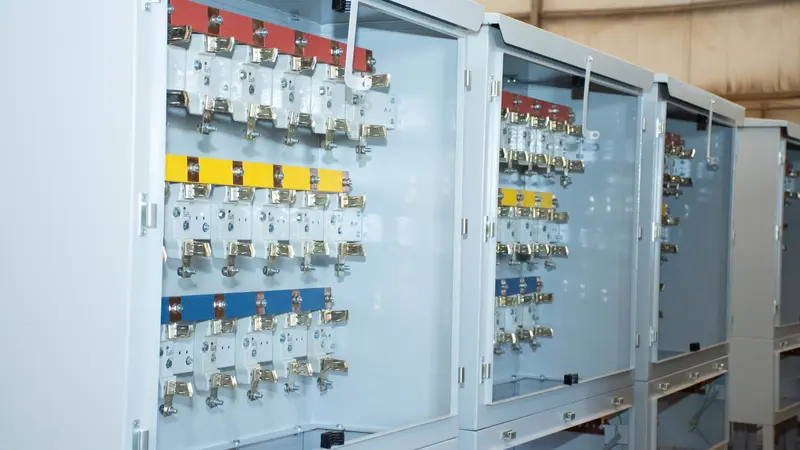
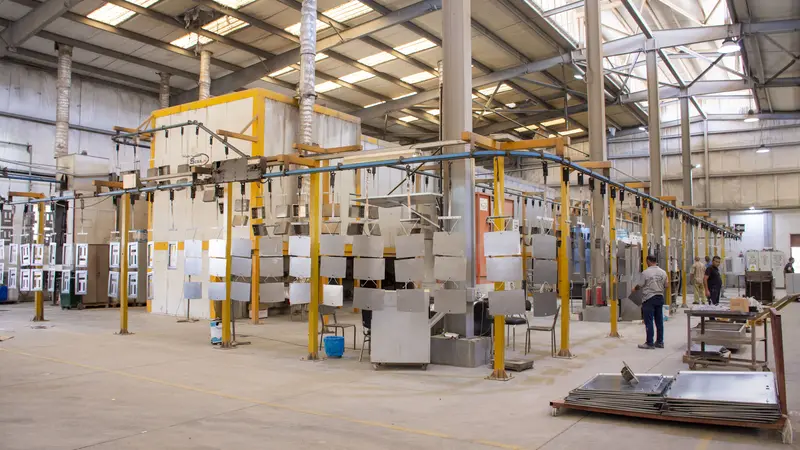
SEGA M designs and builds low-voltage switchboards in its 30,000 m² factory in 10th of Ramadan City, Egypt. The range covers the type-tested NSFB MCB board (160 A, 16 kA for 1 s), the MFB MCCB load centre (250 A and 400 A, 36 kA for 1 s) and SIVACON S8 for main distribution, built to IEC 61439-2. SIVACON S8 boards built by SEGA M carry EEHC approval up to 3,600 A, and the company is certified to ISO 9001, ISO 14001 and ISO 45001 by TÜV NORD.
Send us your single-line diagram and the ratings above, and our engineers will come back with a technical and commercial offer. Our switchboard RFQ checklist lists everything we need.
Frequently asked questions
Is "type tested" still a valid term?
IEC 61439 no longer uses it. The current terms are design verification and routine verification. Many specifications still say "type tested"; a board verified to IEC 61439 meets that intent.
Which part of IEC 61439 applies to a main switchboard?
IEC 61439-2, for power switchgear and controlgear assemblies, read together with the general rules in IEC 61439-1.
Can a panel builder change components in a verified design?
Only within the rules of the original manufacturer's design. Changes outside them need new design verification.
Does SEGA M test every board?
Yes. Every SEGA M switchboard receives routine verification in the factory before shipping, and customers can attend the factory acceptance test.